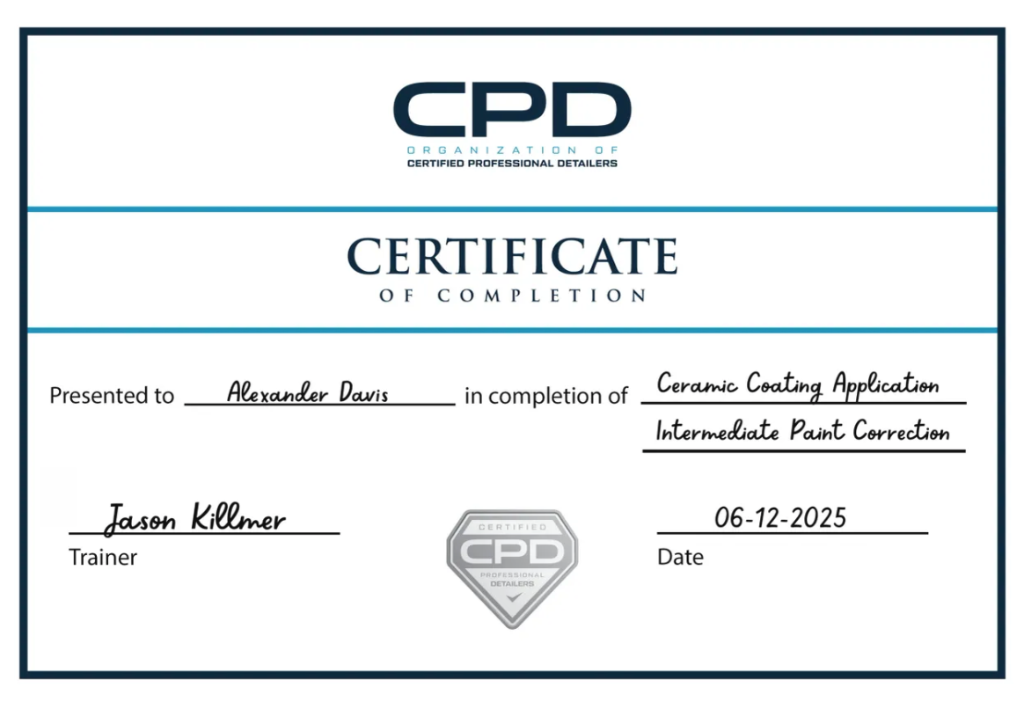
If you're just starting your journey into the world of professional car detailing, or if you're a vehicle owner looking for the perfect person to trust with your paint, you've probably asked the same question: Do certifications actually matter?
It's a hot topic in the industry. I've seen some detailers frame certifications as the "be-all and end-all" of quality, while others argue that experience is the only teacher that counts. As someone who has invested in my own training, I want to pull back the curtain and share my perspective on what these credentials really represent.
What Exactly Is a Detailing Certification?
Think of a certification as a formal stamp of approval that a detailer has undergone structured, professional training. These programs usually cover specialized services that require technical finesse, such as:
- Ceramic Coatings: (I personally hold two of these!)
- Paint Protection Film (PPF)
- Window Tinting
The interesting thing is that not all certifications are strictly about "detailing" in the traditional sense. I once met a detailer in Washington state who held a certification for properly removing and reinstalling child safety seats. It sounds quirky, but for busy parents, that's a massive value-add, and a unique service he can charge for.
Does a Certificate Mean Zero Mistakes?
Let me be completely transparent: Absolutely not.
Detailing is a craft, not a factory process. Every car that rolls into my shop is different. I have to constantly adapt my approach based on the vehicle's age, the condition of the clear coat, its history, and how the owner uses it.
Even the most certified expert can make a mistake. However, certifications drastically reduce the likelihood of a "royal mistake." For example, if I'm working on a roof panel where the clear coat is running thin, my training kicks in. Instead of grabbing an aggressive pad, I know exactly which combination of polish and technique will provide the best result without burning through the finish. Training gives you the knowledge to play it safe when the stakes are high.
How Many Certifications Should a Detailer Have?
There's no "magic number," as it often comes down to budget and the type of clientele you want to attract. However, my rule of thumb is simple: Aim for at least one solid certification per core service.
When you get trained, you aren't just learning "how" to do a job; you're learning the "do's and don'ts" from someone who has already mastered the craft. I recall taking a wetsanding course from one of the best in the world, Jason Kilmer. Even though I don't use that specific skill every day, because it's incredibly tedious and a niche request, when a client does ask for it, I have the confidence and technique to deliver. That training gives me a distinct advantage over someone who is trying to "wing it" through YouTube tutorials.
Are Certifications the Only Deciding Factor?
I'd argue that if a certification is the only thing you're looking at, you might be missing the bigger picture.
Certifications are a foundation, but they must be paired with hands-on, real-world experience. I'll tell you something most people won't: Perfection is a myth. I strive for it on every single job, but just like in art or music, true "perfection" is rarely attainable.
However, when you take the time to get certified, you're essentially paying to fast-track your learning curve. You're learning from someone else's past mistakes so you don't have to make them yourself. When you combine that structured knowledge with hundreds of hours of actual shop experience, you get results that are consistently higher quality and achieved much faster than someone trying to figure it out alone.
The Bottom Line
If you're a detailer, invest in training. It's the best way to level up your craft. If you're a car owner looking to hire a pro, look for a combination of certifications and a portfolio of work.
At the end of the day, a certificate tells me that a detailer cares enough about their trade to seek out the best. But their track record? That's what proves they know how to put that knowledge to work.